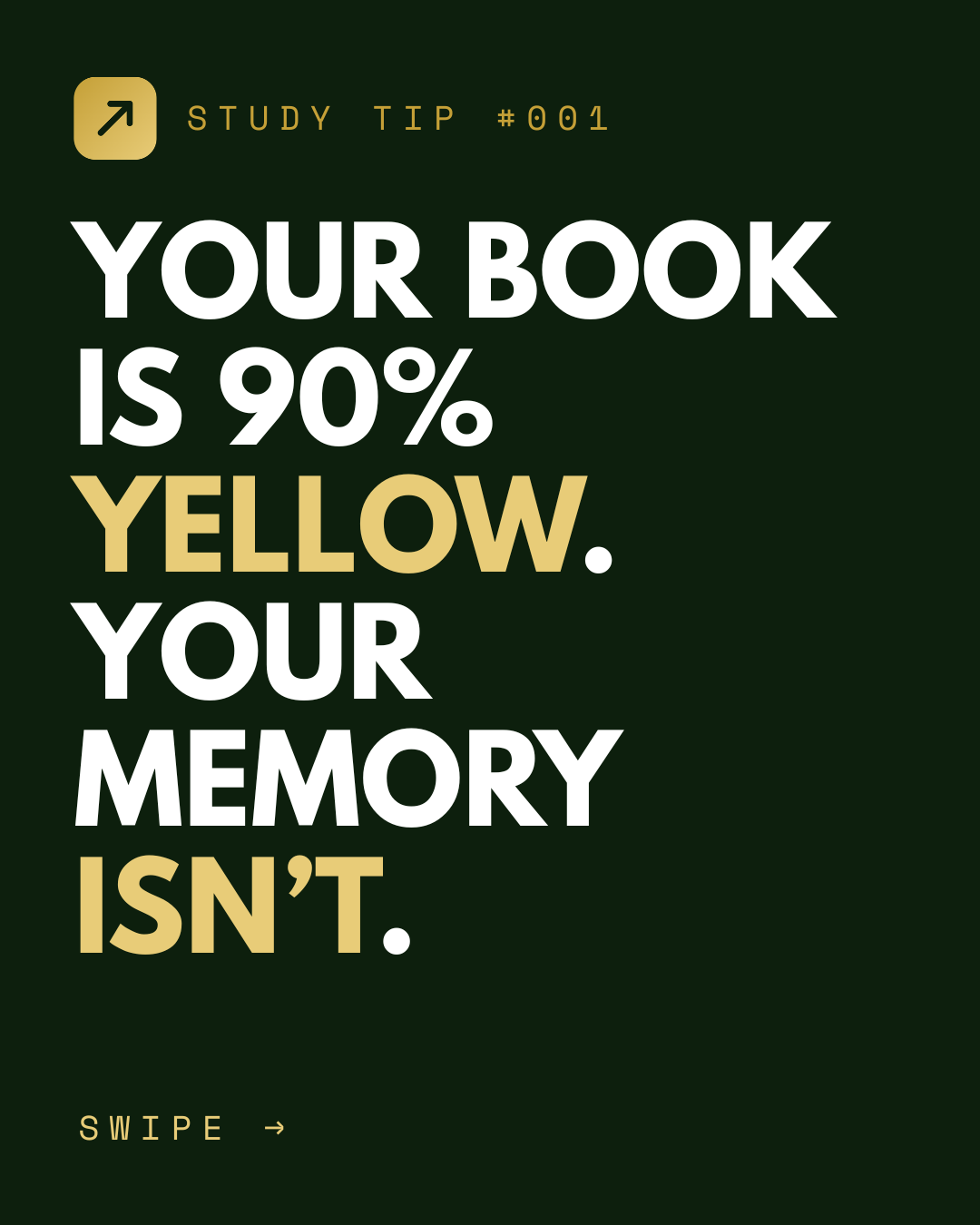
Why highlighting feels productive (but usually isn't)
Highlighting and re-reading are the most popular ways to study, and research rates them among the least effective. Here's why they feel so good, and how to make the time you spend on them actually count.
You open your Biochem book the night before the exam. Two hours later, the page is basically yellow. You feel like you studied. Then the exam starts, and the question asks about the one thing you highlighted twice... and you can't remember what it said.
If that sounds familiar, you're not lazy and you're not "bad at memorizing." You were using one of the most popular study methods in the world. It just happens to be one of the least effective.
Why highlighting feels so productive
Highlighting gives you a lot of signs that you're working:
- The page changes color, so you can see your progress.
- You're reading every line, so it feels thorough.
- When you look back at the page, it looks familiar.
That last one is the trap. We'll come back to it.
What the research says
In 2013, a group of learning scientists reviewed the research on ten common study techniques and rated how useful each one actually is for students [1]. Highlighting and re-reading were both rated "low utility": across studies, they didn't reliably improve how well students did on tests.
At the other end of the same review, two techniques got the top rating: practice testing (quizzing yourself) and spaced practice (spreading your studying out over time) [1].
So the two methods most of us lean on the most landed near the bottom, and the two that feel harder landed at the top.
The real problem: familiar isn't the same as remembered
When you re-read a highlighted page, your brain goes: "I know this." And you do recognize it. But recognizing something when it's right in front of you is very different from pulling it out of your memory when it isn't, which is exactly what an exam asks you to do.
Researchers call this an illusion of competence. In one survey, most college students said they studied by repeatedly re-reading their notes or textbook, and only a few said they tested themselves [3]. Re-reading feels like it's working, so students keep doing it, even though the feeling doesn't match how much they'll actually remember later.
That's why the yellow page is so convincing. It's familiar. Familiar feels like knowing.
So should you stop highlighting?
Not necessarily. A later review looked at five popular study strategies, including highlighting and re-reading, and focused on how students use them: the common pitfalls, and better ways to use each one [2]. Highlighting isn't useless by itself. The problem is how most of us do it: everything, on the first pass, with no plan for what happens next.
Here's how to make your highlighter work for you:
- Read first, highlight after. Read a section all the way through, then go back and mark only what matters. Highlighting while you read for the first time is how whole pages turn yellow.
- Highlight less. If everything is important, nothing stands out. Aim for the one or two lines per section you'd actually want to be asked about.
- Turn every highlight into a question. In the margin, write the question that highlight answers. "Most common cause of...?" "First-line drug for...?" Now your highlights are a quiz you can take later.
That third step is the big one, because it turns highlighting into something closer to practice testing, the method that rated highest [1].
What to do instead: make your brain work for it
The shift is simple: stop asking "Have I read this?" and start asking "Can I recall this?"
- Close the book and write down everything you remember about the topic. Then check.
- Cover the page and answer the margin questions you wrote.
- Do practice questions on the topic before you feel ready.
It will feel harder and slower than re-reading. That's normal, and it's a good sign: the effort of pulling something out of memory is part of what makes it stick. We'll go deeper on this in the next post on active recall.
Try this tonight
Pick the topic you studied most recently and do this, in 10 minutes:
- Close your notes.
- Write down everything you remember (bullet points are fine).
- Open your notes and compare. Circle what you missed.
What you circled is your study list for tomorrow. That's it. Less yellow, more remembering.
References
- Dunlosky, J., Rawson, K. A., Marsh, E. J., Nathan, M. J., & Willingham, D. T. (2013). Improving students' learning with effective learning techniques: Promising directions from cognitive and educational psychology. Psychological Science in the Public Interest, 14(1), 4-58. doi.org/10.1177/1529100612453266
- Miyatsu, T., Nguyen, K., & McDaniel, M. A. (2018). Five popular study strategies: Their pitfalls and optimal implementations. Perspectives on Psychological Science, 13(3), 390-407. doi.org/10.1177/1745691617710510
- Karpicke, J. D., Butler, A. C., & Roediger, H. L. (2009). Metacognitive strategies in student learning: Do students practise retrieval when they study on their own? Memory, 17(4), 471-479. doi.org/10.1080/09658210802647009